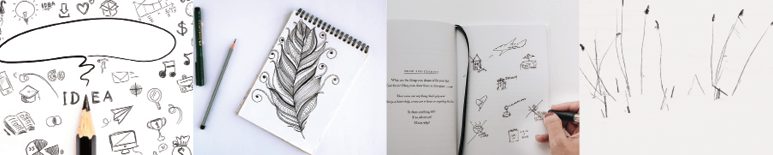
This is How I Pause: I Connect With God Through Doodling!
Lindsay is an artist with many years of experience both in teaching and in conducting creative workshops … In addition, she continues to pursue her ministry as a prophetic artist … She creates divinely inspired works of art from nature, daydreaming of His impressions, pausing before His creation, breathing in His presence. Today she shares with us how she connects with God.
This Is How I Pause:
I Connect With God Through Doodling!
I was born in an era when telephones were plugged into a phone jack, where the mouth piece could be held in the crook of your neck and tilt of your head, more often than not my fingers were free and with pencil in hand I doodled through various conversations…
Doodling allows us to incubate thoughts while “chatting”. They are in essence wondering lines taken for a walk through our subconscious meanderings. They help capture our insights that are partly “seen” and “felt”. Through this naive process, we draw, we indulge our senses … layers of drawn-insight, once cloaked with vagueness, come to light in a freeing-messy-manner through lines that are as unique as a persons’ signature.
The really precious conditions for doodling are … to pause and breathe … to let the mind wander and to day dream …
Be still and consider for a moment … when last you indulged in the act of doodling?
Doodling is an invited right brain activity that surfaces when the logical, left brain is otherwise occupied and it can even lead to something inspirational! Like “mind-mapping”, where information once subconsciously realized is amplified … in the sense that something which was once vaguely perceived now becomes a concrete thought, captured with lines or skeletal forms.
We conceive in a moment, becoming aware of and discovering more about the world around us. Sensory information is comprehensible … doodles can be “translated” … it is here a person makes their doodles their own.
To doodle well, requires a sense of awe and a profound realization, that there is more to life than meets the casual glance! Imagine doodling in the company of our Creator God, what inner thoughts could be revealed through the power of the Holy Spirit? Doodling is revelation made visible, seeing something that doesn’t exist already! I invite you to bring your inner-doodles to life and that way be a playmate with God.
With a small leap I would like to cover the ground between doodling and pure contour drawing.
Pure contour drawing is a creative exercise best done in rhythmical step with a snail … very, very slowly! Well suited for our pause-breathe-challenge. For reasons that are still unclear, pure contour drawing is one of the key exercises in learning to draw. Let us attempt a contour exercise ourselves through the inspiration and guidance from Betty Edward’s book, Drawing on the Right Side of the Brain …
“It is a paradox. Pure contour drawing, which doesn’t produce a “good” drawing (in students’ estimations), is the best exercise for effectively and efficiently causing students later to achieve good drawing. Even more important, though, this is the exercise that revives our childhood wonder and the sense of beauty found in ordinary things. The most important reason for this exercise is that pure contour drawing apparently causes Left brain-mode to “reject the task” enabling you to shift to Right brain-mode.” Betty Edwards
I have taken this exercise from Betty Edward’s book Drawing on the Right Side of the Brain, I quote: “Gaze at a single wrinkle in your palm. Place your pencil on the paper and begin to draw just that edge. As your eyes track the direction of the edge very slowly, one millimetre at a time, your pencil will record your perceptions. If the edge changes direction, so does your pencil. If the edge intersects with another edge, follow that new information slowly with your eyes, while your pencil simultaneously records every detail. An important point: Your pencil can record only what you see – nothing more, nothing less – at the moment of seeing. Your hand and pencil function like a seismograph, responding to your actual perceptions. Do not be tempted to look at your page – keep your eyes focused on your hand. Remember you are not concerned about whether the drawing looks like a hand. You want to record your perceptions.”
“If you experience painful objections from your L-Mode (What am I doing this for? This is really stupid) try your best to keep on drawing. The protests from the left will fade out and your mind will become quiet. You will find yourself fascinated by the wonder and complexity of what you are seeing. When that change takes place, you will have shifted to the visual mode and you will be “really drawing” and you will be in the correct mode for being creative.”
Acquiring perceptual skills and becoming adept in the “art of seeing” will set you head and shoulders above other “creative’s” – many of whom struggle to “see” as they are not in the correct mode for creativity. As your perceptual skills increase, your ability to create and even draw what you “see” will increase, and you will observe your style forming. Guard it, nurture it, and cherish it, for your style expresses your inner voice! As Edgar Degas says… “Art is not what you see, but what you make others see. We paint best that which is most familiar to us, we see best that which is new to us”